The BBC confirmed last month that DIY SOS will be "rested" in 2027 while it finds savings, with a spin-off revisiting past builds in its place (ITV News). After more than 25 years of turning up when a family's project had stalled, the van is being parked for a while.
The premise never really changed. Someone starts something with the best intentions and real determination, life gets in the way, and the job stops being something they can finish on their own. Then a crew of people who know exactly what they're doing turn up, roll their sleeves up and get it over the line. Usually with tears, occasionally with a ramp.
Event technology has its own version of that story, and it isn't taking a year off.
The event version of a half-finished extension
It usually starts well. You've chosen a self-serve event platform, the demo was convincing and the feature list covers everything on the brief. Then the brief turns out to be a bit more particular than the demo event was.
Delegates, speakers and exhibitors each need a different registration journey. Some registrations need approving by a manager before they're confirmed. The client's brand guidelines run to forty pages and they mean every one of them. And there's one thing the client considers absolutely essential that the software doesn't quite do.
The platform can probably do most of it. Working out how is another matter, and "it's all in the knowledge base" isn't much comfort when invitations are due out on Thursday. If a platform can do what you need but you can't make it happen, it hasn't solved your problem yet. It's a half-finished extension with a very good set of instructions.
When is self-serve event software enough?
For plenty of events, self-serve is exactly right. A straightforward registration form, a branded page, confirmation and reminder emails, check-in on the day: a good platform should let your team do all of that without picking up the phone to anyone.
It tends to stop being enough when you see things like these:
- Different attendee types need different questions, instructions, check-in and follow-up.
- Registrations need approval rules, invitation codes or capacity limits per session.
- The client has strict branding, their own domain and opinions about fonts.
- The event has to fit into other systems, such as a CRM or an internal sign-on.
- You're an agency running events for several clients, each wanting it to look like theirs.
- The deadline is close and nobody on the team has time to become a platform expert this week.
None of that means self-serve was the wrong choice. It means you've reached the point where you need a crew, not another help article.
What should "help" look like?
There are two kinds, and a good supplier offers both. Sometimes you just need someone to set things up with you: build the registration journeys, configure the approval rules, check the emails go to the right people. Sometimes the platform itself needs adapting, because your event genuinely needs something it doesn't do yet.
Neither should be a "computer says no" moment. We once worked with an organiser (call her Julie) who needed a supplier event where every type of attendee had different questions, instructions, ways to check in and follow-up messages. Two off-the-shelf systems couldn't do all of it, and a bespoke build missed the things only event people would think of. We adapted our existing platform around her event instead, so she could run it her way rather than simplifying the event to fit the software.
That's the DIY SOS model, really: you keep ownership of your project, and people who've done it hundreds of times make sure it actually gets finished.
Why not just build it yourself?
It's never been easier to build software. With AI tools, an event agency can produce a registration site that looks exactly how they imagined, and we can see the appeal. We use AI in our own development too.
But a site that looks right isn't the same as a platform that's been looked after. The client's procurement team will arrive with a security questionnaire. Someone needs to commission a penetration test and fix what it finds. And when a bug appears at nine in the evening with 400 guests arriving the next morning, someone has to pick up the phone. Reporting, reliability, data protection and updates all still need doing, however the software was built. On DIY SOS, the building inspector still turns up at the end.
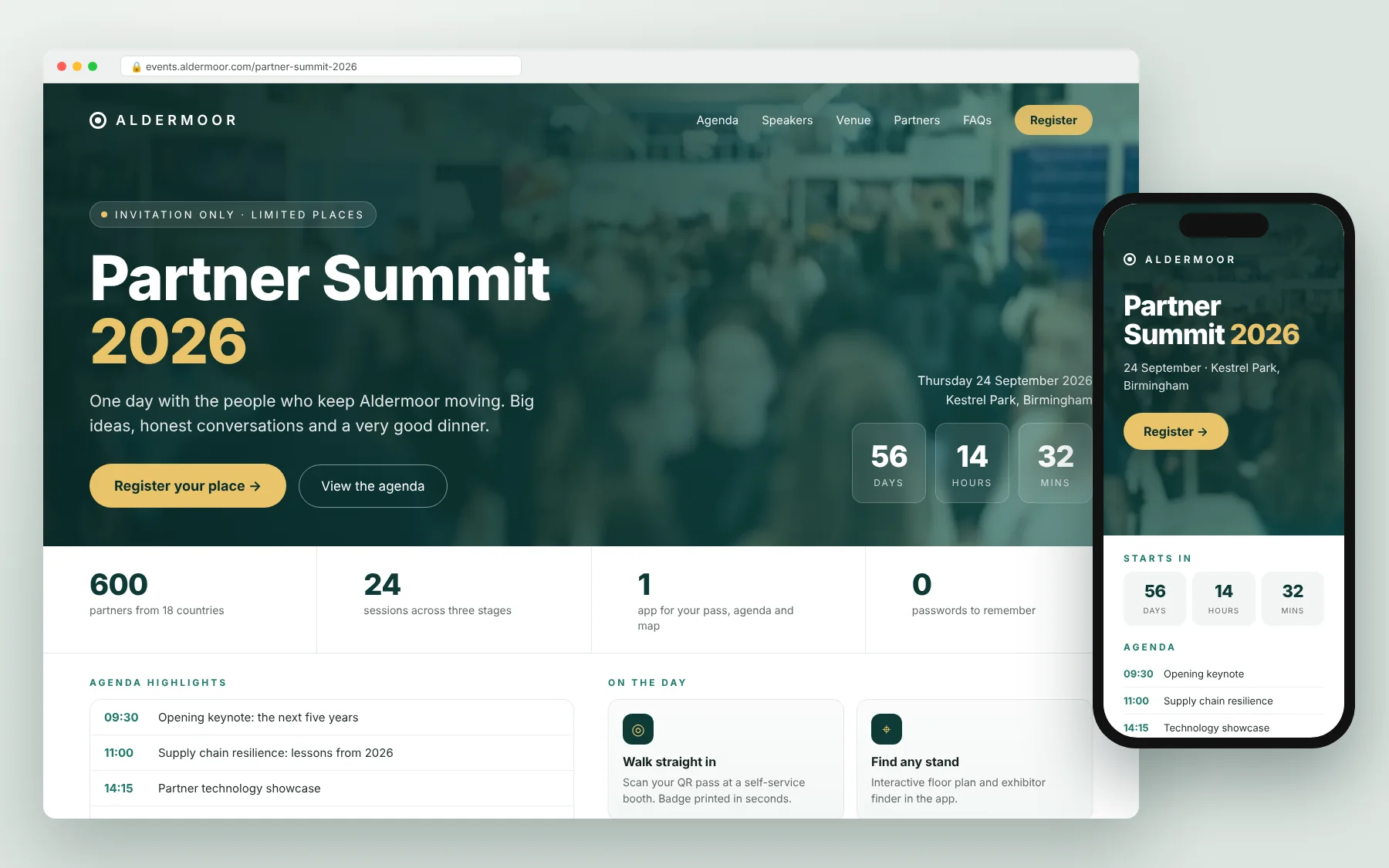
A bespoke event site doesn't have to mean building new software from scratch. It can sit on an established platform that already has the registration, communications, check-in, analytics and years of operational experience behind it, with your brand on the front. That's what a white-label event platform is for.
What to ask before you choose an event platform
- Can our team run straightforward events entirely ourselves?
- When a brief is more complicated, who helps us set it up, and how quickly?
- If we need something the platform doesn't do, will you adapt it, and what does that involve?
- Who handles security questionnaires, penetration testing and data protection?
- Who answers the phone the night before an event?
- Can it carry our brand, or our clients' brands, on our own domains?
If the answers to the middle four are vague, you may be buying the materials without the crew.
We're not taking a year off
Mitingu was built on the idea that event platforms should offer both: the freedom to do it yourself, and people who'll step up when you need them. Your team can run events on their own, from branded registration and automated emails to the attendee app and onsite check-in. When a brief needs more, we set it up with you or adapt the platform, and we're there the night before. We've been doing it for over a decade, and agencies use it to deliver events for several clients under each client's own brand.
If you've got an event that's turned into a half-finished extension, talk to us. Tears optional. Ramp available on request.
You might also like: Your event app has AI matchmaking. Your guest just wants their pass.